Thursday, December 19, 2013

Micro Data Centers: It's a Small World After All !


When we think of Data Centers, we usually visualize large sexy facilities with row upon row of servers neatly arranged in aisles, often glowing under blue and green Hollywood style lighting! 


That's not what I'm going to blog about today..... 

I'm going to talk about the "Micro" data center. There's a niche market - small, but out there nevertheless, that focuses on a few racks, sometimes a few servers bundled in an enclosure that's either simply secured or elaborately weather tight.  It makes sense for certain applications where the need for deploying IT servers is choked by the facility's ability to provide proper space, power or cooling.  The idea is that the enclosure is environmentally isolated, fully cooled and powered, and tightly secured. It can be assembled in a factory, tested, shipped and dropped anywhere ready for plug and play. 

They are branded as:
  • Micro Data Centers, 
  • Data Centers in a Row, 
  • Tactical Mobile Data Center 
The market for Micro Data Centers was somewhat limited to isolated clients with needs for HPC rapid deployments.  That is until 2012 when FAA and AOL announced plans to install Micro Data Centers provided by Elliptical Mobile Solutions on a large scale.  (FAA in April 2013 and AOL in July 2012). The news was well publicized but we didn't see a stampede of other companies anxiously signing similar deals. I would say much of the current interest is driven by the military with demand for tactical mobile high performance computing needs. Servers in vault-like enclosure that can be transported to remote locations and can withstand harsh weather conditions. 

But maybe I'm mistaken so your input is welcome. 

I'll say a closing remark here before adding the list of vendors.  As energy windows from ASHRAE are widened (think ambient cooling minus chillers, large UPS') and software applications for this type of install are worked out, I see a growing contender worthy of consideration. 

Who's currently out there in the world of Micro Data Centers; below is a list of several selected vendors but is by no means inclusive of this niche industry. 

1. Elliptical Mobile Solutions takes the lead in this arena. They offer indoor/outdoor solutions and have demonstrated demand for their product. 
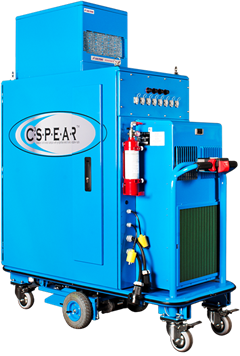

 
2. Emerson Liebert SmartRow TM


3. SGI Mobirack


4. MicroTech MicroPodd

5. Black Box Climate Cabinets


8. RittalData Center Container


9. Fire & Ice


If I missed a vendor, please chime in and add your comments!


Friday, November 22, 2013

Fire Protection Below Raised Floors: A Paragraph in NFPA 13 Carries a Lot of Weight

I

The paragraph above is extracted from NFPA-13, 2010.  

21.14.2.3 (highlighted in yellow).  To put things in context, this paragraph is tucked away on page 209 (Chapter 21) of the code. The code is approximately 400 pages long. It is "extracted" from NFPA 75 - 2010 Standard for the Fire Protection of Information Technology Equipment; perhaps as a convenience.


In the 2013 edition of NFPA 75, the paragraph is located in Chapter 22 as 22.14.2.3. A couple of clarifications were introduced as follows:


Other than the few exceptions introduced in 2013, the requirements are clear: You must provide a fire protection system below a raised floor and you have three options to pick from.  

So whether you agree or disagree, these few paragraphs are embedded into NFPA 13 and hence the safest bet would be to assume that they are enforceable by the Authorities Having Jurisdiction (AHJ) unless proven otherwise! Designers, owners, and operators need to be aware of that. 

Hopefully combustible material is not stored below raised floors, but beyond that, I have some questions that I cannot but ask:

  • I don't see a height requirement of a raised floor specified in the code. I can understand a 3 or 4 foot raised floor, but would a 12" still require it? Who makes that judgement?
  • Cable trays are often installed below raised floor, how is sprinkler coverage affected? What/where is the guideline to design a sprinkler layout with cable trays as obstructions?
  • Are local AHJs enforcing this?  
  • How many manufacturers make sprinkler heads that are approved for such concealed spaces?
  • In a dynamic environment like a data center where you always have folks pulling cable or modifying what is already installed, is a more hazardous condition being created by introducing water piping below the floor?
  • Would signage be required on the floor indicating locations of sprinkler heads?


Tuesday, November 5, 2013

Saudi Arabia Leads in the Number of Colo Data Centers in the Middle East

The website Data Center Map has some interesting stats regarding worldwide colo sites. The one that caught my attention is regarding the distribution of data centers throughout the Middle East excluding Turkey. 


Very impressive results from Saudi Arabia; they quietly lead other neighboring countries in the number of colo sites. This is surprising considering that most of the data center "MEA" mainstream headlines come out of the Emirates and Qatar but it shows that they lag behind Saudi Arabia. 


Data Center Maps' first page has the following quote:


About Data Center Map


Data Center Map acts as a link between potential customers and suppliers of DC services worldwide, such as colocation, dedicated servers, cloud servers, managed hosting, IP transit and many other hosting services. Apart from that our comprehensive database also covers other relevant aspects of the industry, such as internet exchange points, presence of fiber providers, details about network carriers and other details that can be relevant when looking for colocation.

I don't how accurate and how frequent the stats are updated, but the map does show locations and quantities as one zooms in and out and the data is quite helpful for clients and users. 


Wednesday, October 23, 2013

Search Interest Results for "Modular Data Centers"

One can check the Search Interest on anything using Google Trends. (see the yellow comments box, which explains how they statistically graph the trend). But in simple terms, type up any keyword and the graph will accumulate all the online searches by other folks over the time frame.  It even tells you the countries where the searches had the most hits. 

One statistic I am interested to follow up on is Modular Data Centers


The graph above shows how the interest in MDC's shot up in 2009 and peaked around 2011. Does this chart offer any crystal ball predictions? Certainly not. Take it for what it is: just another tidbit in data mining that's worth looking at.  What's interesting is the renewed interest in MDC's since the beginning of 2013; not at the same levels as 2011, but getting there! 

Are you bored? For a more exciting chart, try the keyword BANK RUNS aka Financial Panic!

Thursday, October 17, 2013

An Update to the Performance of Data Center Stocks in 2013: Cloudy With A Chance of Winter Sprouts

It has been nearly nine months since I posted about Data Center Stocks. On January 29th, 2013, I looked at the performance of leading stocks in the cloud sector and I didn't like what I saw. Here's what I wrote then:


"The worse case would be that the street has figured that this space is getting saturated and needs a breather to catch up. That's called sector rotation, as those darling companies go out of favor.  That's a version of the story that we're not particularly thrilled to hear as it takes many months to unfold and could put a drag on the entire sector." 

This is the list of stocks that I follow (it excludes the newcomer QTS as I believe they went public in October; it will be added next year)


So where are data center stocks today? Let's look at a cumulative chart for year-to-date (YTD) performance of the entire portfolio. The group's return is 3% as of today's close.


Since the peak at the end of January, the group has consistently made lower highs (green bars), which translates to smart money (big institutions) selling into the rallies.  The good news is that since August, the group seems to have found a floor as I don't see a recurrence of lower lows (red bars). 

Now, how has this group's 3% performance compared to NASDAQ this year? Not too good considering the NASDAQ has appreciated almost 27% YTD. Ouch. 


So while everyone was cheering the cloud this year, big money institutions seemed to be comfortably back on earth! Hopefully we'll see some winter sprouts of hope soon!


Sunday, October 13, 2013

Scheduled Maintenance of Infrastructure and Systems: An Often Forgotten Component of TCO

Proper maintenance of infrastructure is an activity that is often discounted by owners. If you don't believe me, ask any plant manager who operates a 10 year old chiller if his maintenance plan includes the following: Recommissioning, Eddie Current test, Oil Test, tube cleaning, Vibration Test. 


This past Wednesday, I attended the monthly ASHRAE National Capital Chapter meeting and the dinner topic was presented by Bob Baker, PE, Fellow ASHRAE and one of the thought leaders behind ASHRAE Standard 180 (Inspection and Maintenance of Commercial Building HVAC Systems).


The lecture focused on the importance of implementing a Maintenance Plan in a facility using guidelines such as ASHRAE Std. 180 and  FEMP Operations and Maintenance Best Practices.  Mr. Baker showed examples of successfully implemented plans and how they actually reduced the TCO of a system.  This was not particularly aimed at data centers, but we can extend conclusions to any mission critical facility. 

One of the key slides in the lecture (snap shot above) summarized the content of Standard 180. The reason I like this slide is because it captures a "common sense" idea that we often forget to include as part of a maintenance plan. Dialogue and Discussion with the owner/facility manager. It struck me how little we think about this bullet point. Simply talking to the owner and asking him/her what inventory do you have? What documentation do you have? Catalogs of existing equipment? Records? Commissioning reports etc...

Compared with the outcome of an unplanned outage - mainly customer satisfaction and cost, implementing a proper maintenance plan WILL definitely have a cost impact to capital budget, BUT it will result in a reduced TCO in a facility. 

This was definitely one of the lectures that I really enjoyed and want to make it a point to catch up on the content of both 180 and FEMP. 


Friday, September 27, 2013

Total Cost of Ownership Analysis Will Save Your Data Center Money

Total Cost of Ownership is a neat topic that doesn't get enough respect; particularly when managers look at projects through the blinders of Initial Capital Cost.

The chart below, summarizes it all. Here's why:


This is a comparison of two alternatives for a proposed Tier III, 8 MW IT load project:
  1. A Baseline efficient data center that meets ASHRAE energy minimum requirements
  2. The same project but with LEED Platinum requirements  
I'm not going to go through the detailed numbers because I don't want to loose focus on the main point of this post.  

The Base Design in this analysis cost around $40 million. The Platinum Design cost around $56 million. The two points are plotted on the graph at year zero. Most decision makers will stop at this point and choose the Base design because there is less capital expenditures involved. 

What they are missing though is the 20 years of operation and energy costs that are reflected in what we term the Total Cost of Ownership (or Life Cycle Costing).  These cumulative costs over the days and months and years do add up to a hefty amount.  


The graph above is an extraction of the first graph in which I simply captured 8 years into the operating timeframe. (It helps visualize the graphic). The plot shows that the Platinum building total operational costs remain higher than the Base alternative, but only for a short timeframe.  Around the 5th year, the Platinum project starts to cost less to operate than its Base counter. 

Now go back to the first graph above and follow the Magenta line. You will see that the Platinum LEED project over the 20 years lifetime, costs less to operate. To be exact, it costs roughly $140 million less to operate.

There's a lot of engineering economic analysis that happened behind the scenes to get these numbers. We had to look at energy costs, operation costs, maintenance costs, apply a realistic discount rate for borrowing monies, which may differ between one option and the other. 

But the point I want to stress is that planning a project without doing TCO analysis is risky business; the operational costs over the years could drain your bank account.  In this example the LEED Platinum project after the 6th year was the gift that kept on giving and identifying this gift required big picture TCO analysis. 

Monday, July 8, 2013

5 Site Selection Criteria That Will Earn VIP Status for Your Data Center


We often get asked if there are drivers for site selection of a new data center that would push the particular project to the super-marketable-forefront of favorite data centers. 

Well, there are several factors that are cooked into the formula, but here are 5 basic parameters which would give VIP status to any potential site:

1. Cost of Power. Think why Quincy, Ashburn, Prineville etc... attract big data center names. A fraction of difference in utility costs (cents!) make a difference when selecting a site.
2. Availability of Power.  Can the utility absorb 20 MW to 30 MW easily?
3. Size of the incoming electrical feeds. What is the voltage that the utility can provide to the site?
4. Telecom Connectivity. How many telecom providers are available within the vicinity of the site.
5. Tax incentives. Are there any federal, state, or local municipal tax incentives to attract  you to move to the site.

There you go. 

In a nutshell, if you have these five essential parameters working in your favor, you will earn VIP status for your data center pretty quickly!